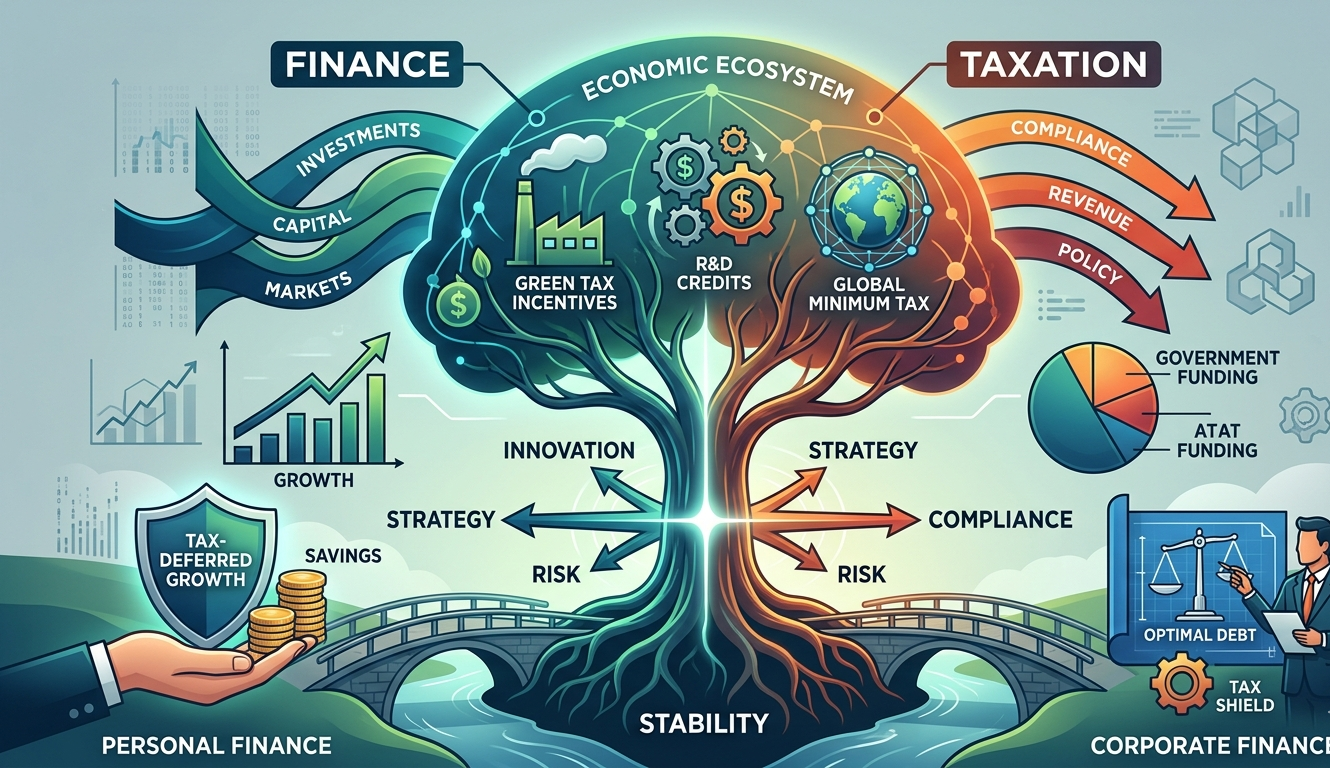
The relationship between taxation and finance is often viewed through the lens of compliance—a necessary “toll” paid to the state. However, in the modern economic landscape, tax finance has evolved into a sophisticated discipline that sits at the intersection of law, accounting, and corporate strategy. It is no longer just about calculating what is owed; it is about understanding how tax policy shapes investment behavior, capital structures, and global trade.
1. The Core Philosophy of Tax Finance
At its heart, tax finance is the study of how tax systems influence the financial decisions of individuals and corporations. Taxes are rarely “neutral.” Whether through deductions, credits, or varying rates, governments use the tax code as a steering mechanism for the economy.
The Concept of “Tax Neutrality”
In a theoretical “perfect” market, taxes would be neutral—meaning they wouldn’t influence an investor’s choice between two different assets. In reality, the Tax Wedge—the difference between the pre-tax and post-tax return on an investment—dictates where capital flows. For a financial manager, the goal is to minimize this wedge while remaining within the bounds of the law, a practice known as tax optimization.
2. Corporate Finance and the Tax Shield
One of the most critical intersections of tax and finance is the Capital Structure Decision. When a company needs to raise money, it typically chooses between debt (loans/bonds) and equity (selling shares).
- The Debt Advantage: In many jurisdictions, interest payments on debt are tax-deductible, whereas dividends paid to shareholders are not. This creates what is known as a Tax Shield.
- The Formula: The value of this shield can be expressed simply as:$$Value\ of\ Tax\ Shield = Debt \times Tax\ Rate$$
- The Trade-off: While debt provides a tax benefit, too much debt increases the risk of bankruptcy. Modern tax finance focuses on finding the “Optimal Capital Structure” where the tax benefits of debt are balanced against the costs of financial distress.
3. International Taxation: The Global Chessboard
In an era of digital commerce and multinational corporations (MNCs), tax finance has become a global game of chess. Companies like Apple, Google, and Amazon operate in dozens of countries, each with its own tax rate.
Transfer Pricing
This is perhaps the most contentious area of international tax finance. Transfer pricing refers to the prices charged between related entities within the same corporation (e.g., a US parent company selling components to its Irish subsidiary). By setting these prices strategically, companies can “shift” profits from high-tax jurisdictions to low-tax ones.
The OECD Pillar Two Agreement
To combat aggressive profit shifting, the OECD recently introduced a Global Minimum Tax of 15%. This represents a seismic shift in tax finance, as it aims to end the “race to the bottom” where countries compete to offer the lowest corporate rates. Financial officers must now account for a “top-up tax” if their effective rate in any country falls below this threshold.
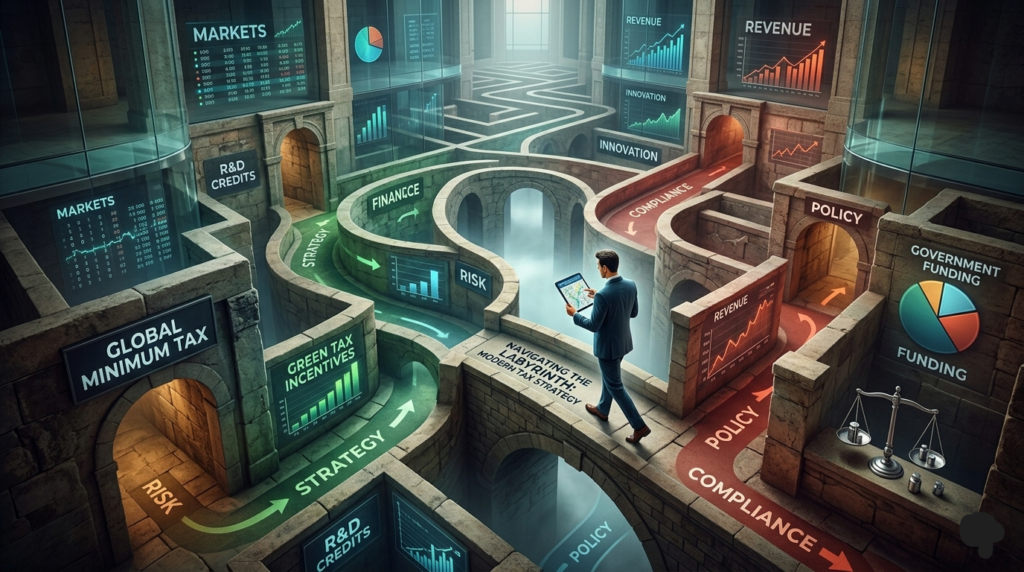
4. Taxation as an Incentive for Innovation
Governments frequently use tax finance to spur specific economic activities. Two of the most prominent examples are:
- R&D Tax Credits: By allowing companies to deduct more than 100% of their research and development costs, or providing direct credits against tax owed, governments lower the financial barrier to innovation.
- Green Finance: As the world moves toward “Net Zero,” tax finance is being used to penalize carbon emissions (Carbon Taxes) and reward renewable energy investments (Investment Tax Credits). This has created a new asset class: Tax Equity, where investors provide capital to green projects in exchange for the associated tax benefits.
5. Personal Finance and Wealth Preservation
For the individual, tax finance is centered on the timing and location of income.
- Tax-Advantaged Accounts: Vehicles like 401(k)s, IRAs, or ISAs allow for “tax-deferred” or “tax-free” growth. The power of compounding is significantly amplified when the “drag” of annual taxation is removed.
- Capital Gains vs. Ordinary Income: Most tax systems tax “passive” income (like selling a stock for a profit) at a lower rate than “active” income (your salary). This disparity is a cornerstone of wealth-building strategy, encouraging long-term investment over short-term consumption.
6. The Rise of “Tax Tech” and Automation
The sheer complexity of modern tax codes—often running into tens of thousands of pages—has made manual compliance impossible for large firms. We are currently seeing a revolution in Tax Technology.
- AI and Machine Learning: Algorithms are now used to scan millions of transactions in real-time to identify tax-saving opportunities or potential audit risks.
- Real-Time Reporting: Many countries are moving toward “Continuous Transaction Controls” (CTCs), where the tax authorities receive data on every invoice the moment it is issued. This moves tax finance from a “once-a-year” event to a real-time data stream.
7. Ethical Considerations: Avoidance vs. Evasion
No discussion of tax finance is complete without addressing the ethical boundary.
- Tax Avoidance: Using legal methods to minimize tax liability (e.g., contributing to a retirement fund).
- Tax Evasion: The illegal non-payment or underpayment of taxes (e.g., hiding income offshore).
The “grey area” between the two is shrinking. Increasingly, investors and consumers are demanding Tax Transparency. Companies that use overly aggressive (though technically legal) tax schemes often face “reputational risk,” which can hurt their stock price more than the tax savings helped it.
8. Conclusion: The Integrated Future
Tax finance is no longer a back-office function. It is a strategic pillar of the modern economy. For the corporation, it is a tool for capital efficiency; for the government, it is a lever for social and environmental change; and for the individual, it is the key to long-term financial security.
As we move toward 2030, the integration of AI, global minimum standards, and “green” tax incentives will ensure that the field remains as dynamic as it is complex. Understanding the flow of money is important, but understanding the tax on that flow is where true financial mastery lies.